Friday, February 28, 2014

Science and Art, Hand in Hand

I feel there is a lot of unnecessary distancing between science and art. Yeah, fine, I know their places in society and, of course, fundamentally they are different such that they cannot be conflated. But, when we look at these from a high, lofty vantage point, we find that they are both interpretations of life, the universe, and everything; tools made by humans.

Okay, so there are several things that have got me pondering this topic over the last week, stemming from casual conversation, screenings, critiques, and pacing this way and that in my dorm. Of course, I think all of you may have some example of where science and art coexist and that is awesome. I guess my plan is to take it a step further to combat a mentality, very prominent in the college environment, that regularly separates these two ways of thinking through curriculum, student perception, and concern of future employment. Hey, a lot of this makes total sense and such thoughts that usually lead to uncertainty really endorse the immobility for art students to be concerned with science and science students to be concerned with art. Yet, like I said, this coordination of art and science is always apparent just sometimes overlooked (especially in an age where, I'm sorry to throw this out there, people make the conscious decision to use mart mediums like film and video games to just, 'check out').

I mean, let's take a look at one of the finest examples of art and science conflating in what seemed to be a movement of mind, body, and soul to a different understanding of reality. 1905 was a landmark year because a certain patent clerk named Albert Einstein developed a theory that would change the way we look at the universe around us. And, highlighted in many of his biographies, like Michio Kaku's compelling account, he came up with these theories by thinking about pictures, elegant and strange pictures. These projections of a new reality, in which he used mathematics as a tool to describe them as well as prove of their existence, required a conflation of alien imagery and sound understanding in mathematical logic. Although this is an assumption, I would guess such a feat would require not only knowledge of science but an undeterred sense of creativity, one that would allow for such bizarre provocation to happen.

Now take a look at this painting, one of my favorite paintings. Marcel Duchamp's 1912 painting signifies much more than an abstraction of a body in motion. It signifies a new way to look at reality, one that obtains its influence from (maybe) the science that has spawned in the previous twenty years before but also one that extracts the societal and psychological significance of technology, maybe describing on a singular canvas the illusory foundations of the moving image, which was gaining interest among not just a select few but among the general population as a viable source of entertainment. Again, let us take that giant step back and climb up on our high vantage point, looking down at the big picture...in a way, and I may argue to a large extent, don't you think Duchamp and Einstein were doing similar things? Weren't they trying to express a new manner by which we see reality? Space and time as a fabric? Hmm...hey, I may be totally wrong but I'd like to think that there is an intriguing unity between the way in which the search for a 'different' reality matriculates a plethora of interpretations through a plethora of media. In the case of the Duchamp, the palette, brush, and canvas were the tools of interpretation. And, instead of being provable or practical, it provides emotional connection within each of us. It asks us to navigate our thoughts and feelings and articulate a response based of some sort of coagulation of these thoughts and feelings.

I think it is crucial for me to point out that no where in this piece am I trying to make the case that one is better than the other. What I am trying to do is express my thoughts that art and science compliment each other in a way that looking at both with a curious eye leads to a better understanding of not just the topics (spacetime, motion picture, modernism, etc.) but also the historical framework and cultural framework that provided the basis for these phenomena. To understand where I am coming from, ask yourself what is the cultural significance of the special theory of relativity, quantum physics, and black holes. Ask yourself what is the cultural significance of The Nude Descends the Staircase, Sherlock Jr., or even A Serious Man. I would argue that such thought and discussion would spot points of intersections between the impact of these scientific and artistic endeavors.

Another example I wanted to being up was one rooted in linguistic importance. I think it is safe to say that people look to someone like Shakespeare for intuitive accounts about the human condition that even scientists can use to explain some sort of experiment (eh...that did not sound convincing at all, whatever, this isn't suppose to be that rigorous). But let me introduce you to Marcel Proust, a French writer from the early 20th century (yes, there is a trend forming here...I'll leave you to figure out why). He made a titanic-sized book titled In Search For Lost Time that has also been broken up into smaller novels. I had the chance to read the first one, Swann's Way, in my history class. Though it is translated from French, what I found was that Proust seemed to want to intensely push the boundaries of language in an attempt to tap into the consciousness of the characters in a manner that elucidated every inch of the mental landscape of a human as if he was mapping the brain out not with data points or computer simulations but with elegiac prose and river-flowing sentences that gradually draw out what can only be deduced as immutable truths. Indeed, it is not a coincidence that Proust has been called a neuroscientist (it's not a definitive truth, mind you, but the mere fact that he has been labelled that holds weight). If not that, he certainly has something to say about psychology.

And it works the other way around, particularly in discussions of art (and many art students may know this already). I find that troubles with critiques or other forms of discussion about artwork originate from a lack of a common understanding or a common ground all parties can inhabit while they discuss there views all in an attempt to rid their opinions with superficiality. If you are one of the two avid readers of my blog, you know where I am going with this. A careful combination of poetics and hermeneutics, I feel, will result in a more formulaic foundation through which discussants or critics can based their opinions on. This is a more rigorous and, in many ways, scientific manner by which we approach art (art as some sort of experiment or research). The only way, though, to achieve such a combination is to understand form, whether it'd be video game form or film form). One of my heroes, David Bordwell, does an incredible job at expressing his approach using poetics and his pieces of many films are constantly illuminating and profound. If we ignore such a method we risk suffering the inevitable consequence of trying to define what words mean and then what they mean to the specified piece...that or a whole lot of unrelated, unnecessary tangents that carry a trajectory into the stratosphere. While, again, this isn't really science, it does have a scientific framework (or a framework influenced by the impact of the scientific method and other rules of logic).

I know many people of the arts who cringe at the idea of bringing more science into their discussions and interpretations of art. I know some people of the sciences who look over art as a secondary form of interpretation to what is going on around them. This is a call to raise the awareness that science and art should not be at odds with each other but serve as compliments. That, in some very special ways, art can illuminate science and science can illuminate art. There sometimes seems to be a complete lack of understanding of how artistry plays a role in science and how much science there is in art (look at Avatar...really, all you have to do is just look at it). But what is really great about the nature of these two languages is those occurrences where humanity's many plans to understand their place in the universe converge at a point of commonality, at a point that highlights the nature of people's curiosity and the direction that their imagination takes them.

Sunday, January 19, 2014

Hoop Dreams :: Reflections on Dreams Deferred


I mean, I was three years old when the documentary Hoop Dreams was released to the Sundance Film Festival in 1994, so discussing this film within the context of its twenty-year anniversary might not make so much sense. I will, though, still attempt to honor the film and its unequivocal legacy because it is a film that delves deep into the fundamental cores of why we go to the movies. It is an episode where we can enter another world, another culture, and another state of mind. It is a time where we notice in this different world the similarities of the human condition and of human struggle we all share. What started as a film that would generally observe the streetball culture in Chicago becomes a film, essentially, about life. Hoop Dreams, by Steve James, Frederick Marx, and Peter Gilbert, is one of the most important documentary films ever made as well as one of the most important films ever made. I guess it goes without saying that this film is actually good (because important doesn't always mean good). What I want to explore is its idea of the evolution of a dream, or of a state of mind that is completely detached from the reality that the two main characters, William Gates and Arthur Agee, use as a formulation of their relationships to themselves and their families. In its epic length, the film shows us the ways in which the kids grow up and how this growth contributes to their understanding of their dreams they felt so passionate about in middle school. This understanding, in turn, contributes to the way in which the communicate their ideas and feelings to the people around them.

There are many powerful scenes that populate the film, some more subtler than others. An example of a subtle moment comes towards the end of the film, when Arthur makes his decision to go to Mineral Area Junior College. He sits on his couch, his mother on one side and his father on the other (after they have recently split...among other things). Both parents make it clear that it is up to him but his father lays it down that, if needed, they can financially support him. Both Arthur and his mother scoff at such a statement; at one point their power and gas were shut off and the mother on welfare so such a remark comes off almost as an insult. But what was felt even more was the direct fragmentation between mother and father, and the idea that Arthur is literally cast in the middle of this conflict, shown in the shot. The recruiter for the college sits there waiting for the answer. Eventually, with a very subdued tone, Arthur agrees to sign the letter of intent. The recruiter asks him if he is excited and with the same subdued voice he uneasily says yes. Is that what he really wanted? Or...was his subdued voice an actual reflection to his subdued persona?

These questions are what went through my mind as I watched this scene. Here is a moment that is generally a great thing (and it really is in this case) but it is coated with a tension that suffocates any sort of truthful feeling Arthur might be experiencing at that moment. Then, through these familial dynamics, a more crucial question rises: Whose dreams are being expressed here? Throughout the film, and obviously through the title itself, dreams are the focus in relation to the actions of these two boys-to-men but it does not just stop there. This film also observes the dreams of other families members and how that ultimately effects the two protagonists. Dreams can intertwine, can conflict, or dissolve not just within an individual but between individuals. Let's return to the aforementioned scene, Arthur's father had explained in detail that he is living his dream vicariously through his son. Combining his guilt he may feel for being a bad father (drug addiction and prison time), what we see is his emphasis of attempting to take substantial action in order to fulfill Arthur's dream or, more specifically, his dream within Arthur. His emphasis led him to make bold statements that seem highly improbably like financially supporting Arthur during college. Arthur's response to this event, and his muffled expression, is a common occurrence throughout the film after dropping out of St. Joe's prep school. Along with his restrained voice he always carried an uneasy smile, a big smile, but an uneasy one which the viewer always takes into account during these moments and wonders whether or not Arthur is making the right choice. Or maybe another way of looking at it is that is he making this choice as a direct result of his father's dreams or the fact that, to put it bluntly, he wants to get the hell out of there more than he wants to play basketball? Nonetheless, Arthur doesn't want to respond truthfully or emotionally when he is thrown into a situation like this, one that he had no control over. Maybe it is even the fact that he has lost trust in his father at that point.

Dreams collide and are obfuscated at this moment and what was once a clear goal is now obscured by experiences and relationships. But, as an evolution goes, the origin is simpler. The film starts out simply with William and Arthur stating that basketball is their lives and they want to make it to the NBA. Yet, throughout the film we encounter many individuals, with both good intentions and bad intentions, applying their dreams onto the two individuals, whether done knowingly or unknowingly. And what I mean by dreams in this context is that many of them construct a chronology (like the St. Joe's basketball coach and Arthur's father) of the boys as to where they will be at this time in the future. Others, and this is applied more to the mothers, essentially give some of their individuality up to share the dream of William and Arthur. William's mother tells the camera that after the failed attempt of Curtis (Will's brother) to go to the NBA, she placed all of her hope on William but her face is weathered in undeterred doubt. In regards to the mothers, whose exchange of their individuality leaves them almost at the mercy of their sons, it is heavily intriguing that both William and Arthur specifically want to better the lives of their mothers, calling attention to their desire to buy them a new house, away from this environment they grow tired of. Arthur goes as far as to explain this to the camera in front of his own father. Another question arises: Are these hoop dreams actually dreams manifested as a way to get out of their living condition? I recall the blues musicians living in the Mississippi delta in the 1920s, 30s, and 40s. Many of the these musicians, though romanticized years later as men who sang about their struggling but 'simple' lives, wanted to make it big and get out of the violent and ferocious world of the south and head to New York City, Chicago, or Los Angeles.

There is another scene, one far more potent and direct, that expresses a dream under fire. Arthur is playing basketball at a local playground; he hasn't seen his father for weeks but he randomly shows up, without a shirt and with a dazed smile on his face. After awkward exchanges between father and son, the father dawdles towards the corner of the street and the camera captures him purchasing drugs. Arthur watches in amazement. Here is a moment where the viewer feels as though they are intruding, a moment where the camera's presence contributes to a growing tension of what is being shot; the position of the filmmakers become part of the scene. What we also see is a dream being directly resisted; through the father's actions, realizations of inner-city life come into contact with the ideal dream of youth and if Arthur has any doubts that may or may not have crept into his mind over his four years of high school, moments like this lend a possibility of contribution to such doubt. Watching this scene, and seeing Arthur's facial expression, I think there was a similarity to feelings between him, the filmmakers, and the audience when we noticed his father walking by, a certain, if you will, "Holy shit," feeling that only simmered down when the scene ended, and this was one of the many moments where I said to myself how this could have all been possibly filmed.


The length of Hoop Dreams is always called into question, and it was the length that spawned the most criticism for the film when it was campaigning for the notorious Oscars of 1994. I personally feel that they are taking for granted an opportunity of understanding a culture that is not usually shown in theatres or on television, a culture not usually shown truthfully. And again, let us take a step back and return to the main point of my analysis. Here is a film that cares for its subjects and constructs a clear narrative of the evolution of a dream and how it is sometimes damaged, mismanaged, ignored, manipulated, or even fueled. One of the greatest moments this film has to offer is when Arthur's mother graduates as the top nursing assistant in her class. A dream accomplished for one, and it makes it easier for her to give up some of her own individuality to help Arthur achieve his goals. There's also a crucial piece of symbolism, manifested in the form of NBA legend and St. Joe's alum, Isiah Thomas. He appears in the first ten minutes of the film, the rest of the time, he appears on television screens and in glass cases next to trophies and acknowledgments. He wavers as a specter that seems to guide the two boys, especially William, whose interactions with the coach seem to be of direct influence of what happened with Isiah. The dream of Isiah, made into the dream of the St. Joe's coach, try to make its way into William's mind. As we watch the story unfold, of William's unlucky streak of devastating injuries and of Arthur's late rise to local stardom, here is a story that, as Roger Ebert said in his essay, "No screenwriter would dare to write this story." Nevertheless, this is a film about dreams, the different forms it can take within different people, and how they develop over time as reality weighs in and the passage of time is felt. This, and being a window into a place in America, my own country, where realities are far different from the realities me and many other people I know face. But, like I said in the beginning, despite these differences we are able to connect with the subjects through emotional familiarity. We cheer when Arthur carries his team to the State finals, we are saddened to see William miss his free throws because these shots are not just shots important to adding another game to the win column of the school's record. These shots mean so much more.


Looking back on it, the basketball games became almost less of a determinant of William and Arthur's choices of their future than what they experienced off the court. It is almost as if their hoop dreams never grow when playing basketball but grow (or shrivel up) when they are not playing basketball. Hoop Dreams will never lose its power, the story is so damn potent and the humans who occupy the story are as complex as we all are...because they are real. I know it will never lose any of its potency with me; there is a significant personal connection I have with this film. Besides the obvious socioeconomic difference I have in relation to William and Arthur, substituting 'Hoop' with 'Film' will encompass much of the same pressures I am dealing with. This is not an attempt for anyone to patronize me, but I wanted to make clear why this film speaks so clearly to me, and why, in contrast to those social and financial difference, I can relate to the two protagonists of the film. My passion for films started out as a dream and, to a very large extent, it is still a dream, a dream that is evolving as I engage myself in one experience after another. This film reveals the fragility of these dreams, and how much you have block from your mind in order to retain the grasp on the dream that you had when you first grabbed hold of it. And, like in the film, this evolution seems to take into effect more so when I'm not filming and when I am sitting here, writing this piece, reflecting on dreams deferred. There's a lot more I can say about that. Another time, maybe.


----------------------------------------------------------------------

I mentioned earlier that this film is a reason why going to the movies is so much fun, highlighting one of the reasons to be its enlightening insight into inner-city life in Chicago. Another reason is the formulation of such a story, meaning the act of filming these moments (some brutally intense), editing it for clarity, and presenting a story that seems like it was written for the screen but maintained its authentic approach. It blends editing styles similar to narrative fiction films with characteristics of the documentary form of cinema vertie. It continuously makes you wonder how this scene was filmed and what were the filmmakers thinking at this point. the acknowledgement of the filmmaker is always present, something documentaries are more clear about as opposed to fiction films. There is a lot that can be said with all of this yet that would require another essay of this length. There were many questions I raised throughout this piece, all of them without answers. How can I really answer them, honestly? I raise these questions in an attempt to approach these events in the film from many different perspectives, because I feel that is the only way to do so if one would like to understand as much as they can of what it going on, which includes how this film was made, which is chronicled in dramatic detail in this article.

Wednesday, January 8, 2014

The Top 13 Films of 2013

This year can easily be characterized as being the year of incredible individual performance. Many of the films on this list contain limited casts and/or focus on really one individual amid an ensemble. I had the gracious opportunity to see these complex and stunning performances on the big screen and to marvel at the actors' confidence and passion in a plethora of stories. Having said that, there is an eclectic mix of films here, including a fair share of documentaries. If you have read a good amount of my posts, though, I do hold a disdain for numbered lists. This is my annual contradiction in attempt to ignite curiosity within the reader, to discover films they would never had even known existed while also, well, sharing my personal favorites if I had to choose personal favorites.

13. Computer Chess
File:Computer Chess.jpg
Yes, I am assured of myself that this film is the strangest one of the year and one of the strangest I have ever seen. Speaking in superlative might not actually do this film justice with its raw eccentricity. But what makes this film endearing is its subject, a tournament where computers built by different colleges (and one private) play chess against each other. In it's pseudo-mockumentary format, Andrew Bujalski explores a place that is obscenely odd, but does so with dry humor and the inherent curiosity of the subject. There is a convincing level of authenticity to the time and place this film is set, with the old computers and the old fashion...right down to the use of specific video cameras and complete with all the visual trash that video can have (like warps and grey lines on the screen). It is a film about the eve of computers as the most powerful machines of civilization and its significance to the human condition. One character pridefully makes a bold prediction that computers will be used for dating...and there you have it.


12. Blue Is the Warmest Color
File:La Vie d'Adèle (movie poster).jpg 
The unexpected big winner at Cannes 2013 comes with a slew of controversy and a hodgepodge of interpretations, most notably the critique on the 'male gaze' that seems to fall upon the two magnificent leads, especially from a thoughtful essay here. Some say it is about homosexuality, others, like in the link, say it is about heterosexuality. I see this film more about sexuality in general, sexuality explored through a growing girl's experience with first love. Adele, played brilliantly by Adele Exarchopoulos, seeks and expresses love physically as if that is the only way she knows how. What transpires in its epic length is the gradual shattering of a young girl's perspective of love. This film, no matter the interpretation, is driven by the courageous performances of the two girls who, to put it simply, depict women in love.

11. A Band Called Death
http://upload.wikimedia.org/wikipedia/en/9/9f/A_Band_Called_Death.jpg 
Much in the same vein of last year's Searching For Sugarman, A Band Called Death is a fascinating story of musical revival. What makes this film so astounding is the familial narrative that creates a powerful tale of music that transcends mere entertainment and forms more of a consciousness for how the band members, all brothers, can perceive life and how memories are ultimately formed and structured. There is a profound significance in regards to this proto-punk band's name, Death, that is gradually explained throughout the duration of the film but the film and its makers make the right choice to not clearly explain it and let the viewer ponder on its magnificence. It also helps that the social actors, the brothers and their families, are infectiously insightful with lives as intriguing as the pulse-pounding beats of their rock and roll. (Note: this filmed first premiered in 2012 but it was not covered by many critics until 2013, so, yea)

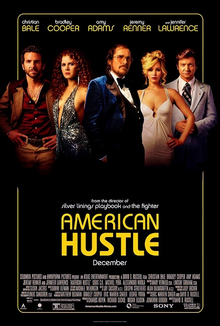
10. American Hustle
http://upload.wikimedia.org/wikipedia/en/8/85/American_Hustle_2013_poster.jpg 
Just as the opening scene of Christian Bale's character, Irving Rosenfeld, performs an elaborate comb-over, the film is all about revealing that things are never what they appear on the surface. And when the film centers on a complex relationship between two con artists (played with charm by Amy Adams and sympathy by Bale), David O. Russell's crime film is all about the glitz and glamor as well as peering past the glitz and glamor to find vulnerable individuals. Despite a somewhat loose plot, Russell succeeds because his cast is eager to explore these vulnerabilities, especially Bradley Cooper, whose Richie Di Maso seems like an FBI agent with anxiety disorder. This can also be seen as Russell's homage to Martin Scorsese (whose infinitely scathing film did not make the list): just note a crucial cameo in the middle of the film as well as Bale's acting style and voice (his voice is very reminiscent to De Niro). American Hustle is a suave crime drama meshed with a compelling human drama to create a story as colorful as the diverse costumes worn by the characters throughout the film.

9. The World's End
File:The World's End poster.jpg 
There are not many films out there that measure character development by how drunk the characters are but, strangely, Edgar Wright's The World's End does this well; actually, he does it better than most of the action filmmakers out there. Though it may not be as cinematically interesting as his epic, and one of the great action films, Hot Fuzz, this film is still damn fun. The reason is twofold: the care Wright gives to his characters to just (you, for character development) act like human beings with feelings and not archives of cliched action film one-liners. Secondly, I would consider Wright as one of the contemporary masters of pacing and suspense (that's right, hopefully an essay later to reinforce that), building tension that never feels forced but feels completely appropriate within that narrative's development. Without getting into too much detail with the actual narrative, Wright brilliantly constructs a plot that happens to be fully functional with the increasingly absurd story that unfolds mainly because the ways in which he sets up character development (again, a lot of it through drinking and drunkenness) and calculated key scenes over time. The World's End and its neurotic story of the alienation we feel as we grow up is a helluva film with a helluva heart.

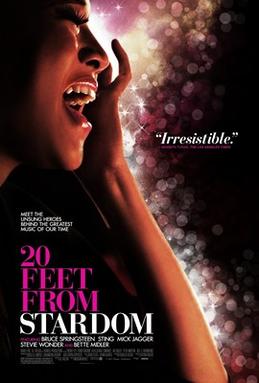
8. 20 Feet From Stardom
File:Twenty Feet From Stardom poster.jpg 
This film needs to be seen to just hear the divine vocals of Lisa Fischer, Darlene Love, Judith Hill, and the many other remarkable voices of a documentary that not only exists to inform but exists as a reflection of what seems to be care and respect for a position so musically important yet continuously understated. 20 Feet From Stardom is a film to ignite curiosity for the eyes and ears as the camera glides across the faces of singers who devote their whole lives to the craft of perfect harmony. You will meet many of the backup singers from your favorite rock and soul songs and trace the unfortunate and often brutal history of these wonderful singers. And this is why the film is important, it is a sort of rectification. Just like Jiro Dreams of Sushi from last year's list, 20 Feet From Stardom is a film showcasing unfiltered passion as the camera closely observes the folded faces of the singers generating vocals straight from their soul.

7. Fruitvale Station
File:Fruitvale Station poster.jpg 
This film has had the unfortunate trajectory that has fallen out of sight for many people, including awards committees (save for the Spirit Awards) and it's unfortunate now because any exposure it deserved to get, both in terms of the story and the new director, Ryan Coogler, will be lost. Here is a film, which I talked about months ago, that observes rather than condones. The film's pace mimics the pacing of life itself, and all of this culminates in a devastating disruption to such a pace where the shock of such disruption left only disillusionment within the minds of Oscar Grant's loved ones as well as the entire nation. Michael B. Jordan (the B is there for a reason) gives a powerful performance by not attacking his subject in dramatic rhetoric but absorbing the significance of Oscar to his loved ones while he was alive. And it is important to celebrate Melanie Diaz and Octavia Spencer as his wife and mother respectively, both give authentic performances the tears your heart up. Do yourself a favor a see this film and tell your friends. It's the least you could do to help out Coogler and his young but promising career.


6. Fill The Void
http://upload.wikimedia.org/wikipedia/en/3/33/Fill_the_Void_%282012_film%29.jpg 
Shout out to my brother Philip for suggesting I see this film when I had no idea what it was. Think of this film as a Jane Austen novel meets Hasidic Judaism. Ok, nevermind, that generalizes it too much. Think of it more as an exploration into human desires, loyalty, and fragility among a rigidly traditional culture. I use 'rigid' not as a negative descriptor but just as an observational tag in the same way the director, Rama Burshtein, observes the culture with sympathy and honesty. In a situation where Shira's (played by Hadas Yaron) sister, who just gave birth and unfortunately passes away in labor, decides whether to marry her sister's husband to raise the child, the audience witnesses a film that, no matter the traditional mannerism and ethnic characteristics that may be foreign to most, illuminates universal struggles under the guise of emotional restrain in the same way Yasujiro Ozu captures these same struggles in Japanese culture within his films. Yet, the most exciting facet of this film is its lead, Hadas Yaron, who portrays her character with potent individualism amid a restrictive culture. It is one of the best performances in recent memory and one that could easily compete with the Oscar frontrunners. Unfortunately, you may never here the name Hadas Yaron again (hopefully I am dead wrong). Nevertheless, Fill the Void tells an unfiltered human story filled with elegant complexities and profound ambiguities all propelled by a grandiose performance by the leading lady.

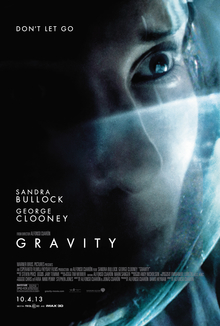
5. Gravity
File:Gravity Poster.jpg 
There is almost an inexplicable perfection for a story dealing with the human frailty expressed in an attempt to understand existence to place itself among the stars. Nothing, even though it has seldom been experienced, feels as vulnerable than to be flying aimlessly in space...with your oxygen depleting. It made so much sense for Alfonso Cuaron to direct Gravity, a film that is most certainly about the symbolic trajectory of a lone survivor in the largest realm imaginable. He revels in the long take, but a long take that is not static but rather fluid and exploratory (just watch his phenomenal science fiction film, Cildren of Men). This film places this technique at its zenith, and the engrossing result is one filled with wonder and anxiety. Seeing this in IMAX 3D was almost necessary as the vulnerability of Sandra Bullock's character, among the inexplicable vastness of space became clearly translated for the viewer. The rest of the film was beautiful to see, if not haunting. Gravity is an exhilarating cinematic experience that not only offers a thoughtful, imaginative story but a story that expands the possibilities of cinema, itself.


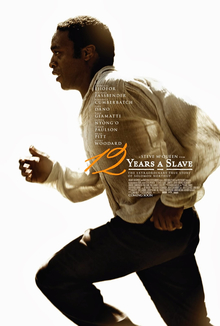
4. 12 Years a Slave
File:12 Years a Slave film poster.jpg 
How can a film so painful be so beautiful? Director Steve McQueen seems to admonish slavery while at the same time having his cinematographer set up shots that feature a whole pallet of colors, interplay between light and shadow, and beauty of the southern landscape. The beauty is the backdrop, setting up a stark contrast to the scathing inhumanity exhibited by many of the delirious characters. Among the many great and darkly illustrious moments there was one scene that stood out: when Brad Pitt's character, Bass, arrives at Edwin Epps (Michael Fassbinder) to build a house, Solomon Northrup, played remarkably by Chiwetel Ejiofor, helps build it. As Bass and Northrup get to know each other, Northrup decides to tell Bass that he was a free man with a family in the north. As Bass looks at him, gently trying to convince him to expose any secret he may have, Ejiofor's mouth opens very slightly, trying to get words out of his mouth. His bottom lip begins to quiver incessantly and his eyes well up. This is the culmination of years of pulverization of not just a human individual but of an identity, so much so that Northrup is afraid to submerge his identity he was once proud of. The viewer witnesses this slow degradation into a man who is just continuing his existence by surviving. Some critics have claimed it to be essential cinema. I agree, and it is cinema that tests our emotional and physical strengths (as well as the cast's). Last year we had Tarantino's Django, which I called into question for its motivation. This film's motivation is without question, and Steve McQueen has risen to be one of the best new filmmakers in the world. With time, I feel this film's importance will only grow.

3. The Act of Killing
http://upload.wikimedia.org/wikipedia/en/c/ca/The_Act_of_Killing_%282012_film%29.jpg
There are many moments in our lives where we are detached witnesses to atrocities in our country or around the world. We absorb them with astonishment and fall into an inescapable disillusionment, simplifying our feelings into one, commonplace question: "How could anyone do such a thing?" The Act of Killing is a remarkable film in that delves into the minds of individuals that are the subject of such a question. The film gives us a chance look upon a possible answer as it follows a couple of Indonesian gangsters as they recreate their own genocides in a film they are making inspired by the Hollywood films that attracts them. What transpires is a reflection on perceptions of violence: the change of perception as one starts as the perpetrator and eventually moves to the victim...and the emotional disconnect that is revealed. It is also a film about film; there is a constant reminder that cinema is a reproduction of reality and, thus, the emotions of the real events are reproductions within the film. The gangsters in the film have different ideas of how to approach the making of their recreation since cinema and the act of reproduction opens up a limitless amount of possibilities of how the killings should be portrayed. This is a nightmarish phantasmagoria of evils revisited, of dark and hardened memories excavated from the depths of years of built-up indifference and detachment. This is also a film about cultural mentality and how one way of thinking, which can be abhorrent to some, can be the motivation for an entire population. What can we make of these men as we watch this film. I don't think I will be able to formulate anything cohesive about my feelings and reflections for a while. One thing I do know is that the main director, Joshua Oppenheimer, embarks on a brave and paramount journey into a world molded by fear, where the term 'gangster' is interchangeable with 'free man,' and an entire modern nation looks upon its history with inconsistent eyes. The film goes in and out of fiction and nonfiction, but we can never tell where the fiction stops and starts, always leaving a sense of unease. I did not know a film like this could be made. It has been made and its a film as necessary to the human race as any that I have seen.

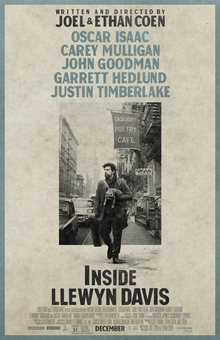
2. Inside Llewyn Davis
File:Inside Llewyn Davis Poster.jpg 
The main character, Llewyn Davis, might have just as much natural talent in getting himself in terrible situations as he does with playing guitar and singing engrossing folk music. Thus lies one of the many ironies in a film filled with ironies that weaves a remarkable tapestry of melancholy. Within their full body of work, this new Coen Bros. film falls in line with films like A Serious Man and The Big Lebowski as distinct character studies within a symbolic historical context (early 90s and Gulf War politics in Lebowski and 60s Midwest Jewish America for A Serious Man) by studying a not so sympathetic character during the early 60s on the eve of a folk revival. The Coen Bros. are at the top of their game and remain, in my mind, as the best contemporary filmmakers. They seem to bring together a crew that effortlessly creates a world so rich in authenticity and detailed in texture that every shot composed within the duration of the film is a necessary shot to not just progress the plot (well, a semblance of a plot) but to encompass the viewer more and more into the minds of the characters (hence the title). Moreover, the Coens not only seem to bring out the best in their actors but also the most unique; take note at the secondary players of the film (including Justin Timberlake, John Goodman, and Garret Hedlund) and how they all carry a certain eccentricity to their mannerisms as well as what they say and how they say it, almost turning into caricatures but not quite. Symbolism is potent in this film, which is of no surprise for a Coen film, so one must throw themselves into the film to fully capture its significance. Of course, Oscar Isaac's phenomenal performance and fist-clenching musical performances are incredible which goes without saying that T-Bone Burnett is also on top of his game and the hottest ticket in town when it comes to truly American films. What a great, intensely emotional film this is. So much so that this film and the next one can be interchangeable as my most enjoyable of the year. It only makes me anticipate more for what the Coen Bros. have next (in terms of historical trends, we might see a bigger budget film).


1. Nebraska 
File:Nebraska Poster.jpg 
We seem to glide with the main characters from Billings, Montana to Lincoln, Nebraska in Alexander Payne's most recent film. There is a sort of softness with the visuals, too, or maybe it's a delicacy (there is one shot of rolling hills with numerous haystacks plotted all around with a pile of sticks in the foreground...it's so delicately shot it looks like we are looking at miniatures). This makes sense, because the leading man, Bruce Dern's Woody Grant, is delicate, albeit harmfully stubborn. Nebraska is first and foremost a road film, but a road film with a huge care in family dynamics as well as a detailed look at the world where the travels take place. This film is all about coming to terms with the past and the generational significance it implies. We see many elderly individuals and with the crisp black and white photography we observe their aged and weathered faces...and how beautiful they are. This film is filled with humor, sometimes so cynically scathing, sometimes gentle. And the performances drive such a bilateral tone, with Bruce Dern giving an astounding performance while June Squibb, who plays Woody's wife, Kate, gives a powerful portrayal of a body-hardened wife rife with dominance but just enough room for unequivocal care. And there has to be something said about Will Forte's performance, who gave me some suspicion because of my ingrained perception of his SNL work, but there is something about his face that is nice to look at and something about his voice which always seems to invoke care and reassurance. Nebraska is a powerful film derived from its simplicity as well as the fact there is something, big or small, that many people can relate to in seeing an illustration of a family dealing with absurdity. And, of course, there is something about Woody, something mysterious. We can't quite peer into his mind no matter what he says, but Payne lingers with him because he knows there's much more, just like how he lingers on the vast Midwest landscape. There is so much more you can say about this film, and in a year with so much intensity, melancholy, cynicism, this film ambitiously tackles the idea that life is filled with all of that...as well as some sentimentality. Face it, we all need it at some point.

---------------------------------------------------------------------------------

I know there are films that you are probably wondering why they are not on the list, like The Wolf of Wall Street (an essay coming soon), that's how all lists go, but I can assure you that this list is as diverse as possible: big-budget films, independent film, foreign films, and documentaries with stories about alien invasions, genocide, marriage, folk music, and even computer chess. There is a lot to learn in watching these films. Maybe not in terms of science (i.e. Gravity) but in terms of emotions, feelings, and ideologies that are present within our fluctuating world such that we now have an acknowledgement of their existence and their possible influence. It's really like battling ignorance one film at a time. So, hopefully this list will inspire further exploration. As for me, we'll see what award season brings. Like always, I hope the films that deserve recognition attain recognition.